Asta Bidspirit | Carlo Bugatti
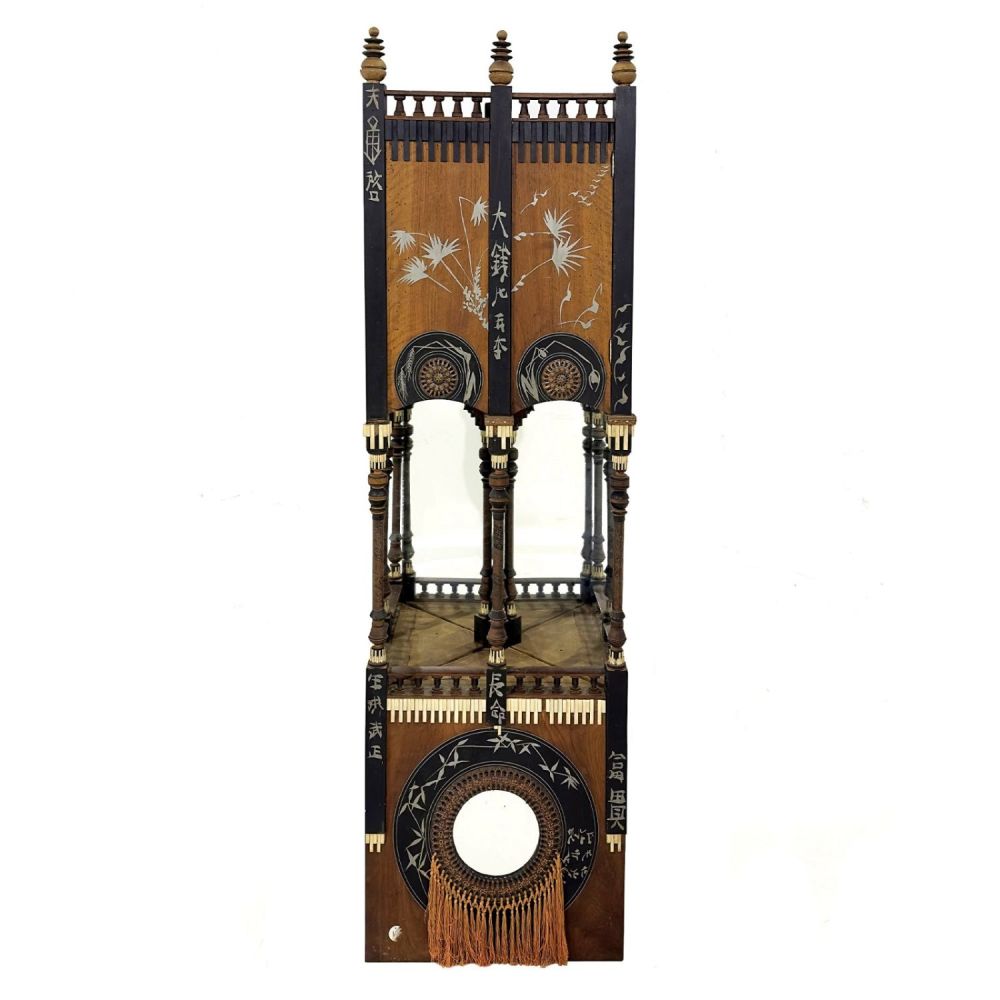
Carlo Bugatti - hanging corner cabinet in partially ebonized wood, inlaid with pewter and bone and decorated with embossed copper applications; the lower part decorated with a mirror disc trimmed with tassels; the walls in mirror (not contemporary) cm. 170x50x25 (some lacks). Lot with free circulation certificate, 7.1.2019 If there is a family in which the refined and eclectic expression of art has reached its peak, this is the Bugatti family. The founder, Carlo, made stylistic originality and refinement pushed almost to excess, the cornerstone of his activity as a fine cabinetmaker. His furniture winks at the Art Nouveau style, but they exclusively share the refined taste of phytomorphic elements and the search for increasingly exclusive ornamental motifs. In a Milan that saw the birth and spread of the Futurist movement (the Bugatti family had direct relationships with Marinetti himself), Carlo, and even more than him his son Ettore with the production of cars, shares the movement's provocative attitude. And it is precisely by recognizing himself in this attitude that he is always in search of that wonder that develops in the almost purely architectural structure of his furniture, reworking the Moorish style in a completely personal way, characterizing it with more generally orientalist tendencies and with influences from Japonist art. . Even the search for materials becomes a characteristic underlying this ostentatious refinement which is also and above all manifested in the artisanal technique performed with exquisite skill: precious woods, parchment, bronzes, ivory, tassels, cords, leathers, ensure that the exotic taste rages in all his works. By participating in the International Exhibition of Decorative and Modern Art in Turin in 1902, the undisputed success of Milanese production was decreed, which has become iconic to this day.The compendium of furniture present in this catalogue, dating back to the end of the 19th and very early 20th centuries, represents a typical creative expression of the artist's more specifically Italian production which is characterized by having marked the transition from the furnishing culture of the late 19th century to the great modernity based on design that entered manufacturing and diffusion in the twentieth century. These are ”multi-material” furniture in which models from the most distant places are reflected: birds painted between bamboo branches highlight a marked taste for the Far East.