Asta Bidspirit | Importante e raro orologio da
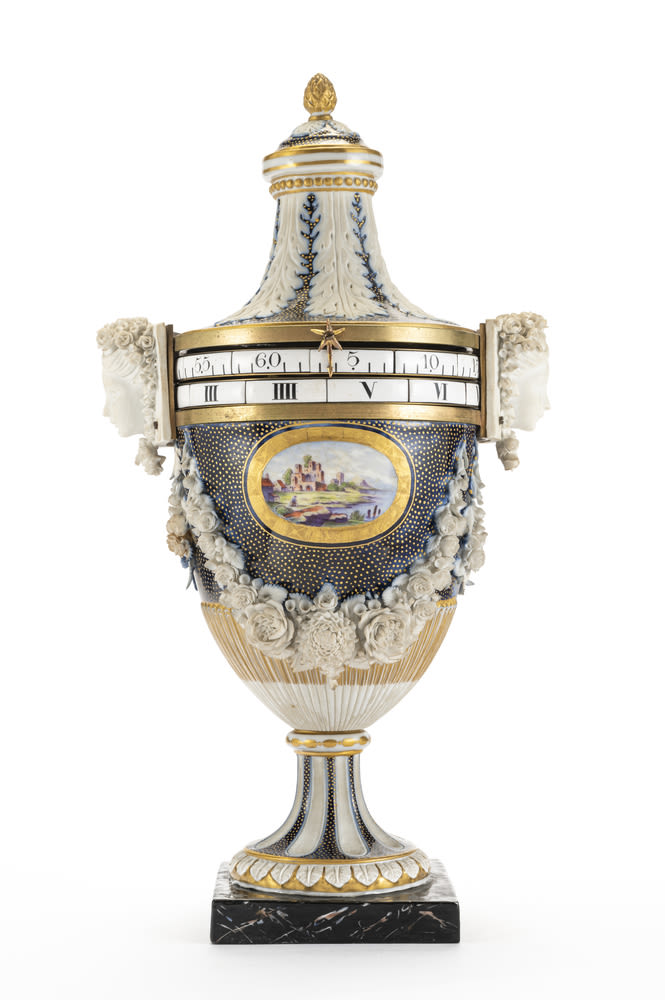
Importante e raro orologio da appoggio %c3%a0 cercles tournants - Importante e raro orologio da appoggio francese del tipo detto à cercles tournants in porcellana della manifattura di Niderviller, a forma di vaso all’antica, con ghirlande e mascheroni in altorilievo in biscuit e raffinatissime decorazioni policrome in riserve, rappresentanti paesaggi nel gusto di Claude Lorrain. Il coperchio è decorato da foglie di acanto in bassorilievo. Marchio in blu nella parte inferiore, con corona e doppia C contrapposta, indicanti il Comte de Custine, proprietario della Manifattura. Fondata nel 1735 a Niderviller (anche Niederviller, nella grafia tedesca) in Lorena, nei pressi del confine con la Germania, la manifattura è una delle più antiche di Francia e fu la seconda a realizzare porcellane. Per la qualità delle sue migliori produzioni fu paragonata a Sèvres. L’orologio presenta movimento con suoneria delle ore e delle mezze, cerchio orario in dodici, in numeri romani e dei minuti di cinque in cinque in cifre arabe. Si tratta di una delle più pregevoli interpretazioni di questa tipologia, di qualità museale. Un orologio simile si conserva presso il Musée Nissim de Camondo di Parigi ed un altro presso il Musée Lorrain di Nancy. Per esemplari analoghi, si vedano in letteratura: ”Tardy, Les Plus Belles Pendules Françaises” (1994), p. 90 e ”Kjellberg, Encyclopédie de la Pendule Française du Moyen Age au XXeme siècle” (1997), p. 301. Circa 1780. A very important and rare French clock of the so-called cercles tournants type. Manufacture of Niderviller porcelain, in the shape of a vase à l’ancienne, with garlands and masks in high-relief in biscuit and very finely painted landscapes in medallions, in the manner of Claude Lorrain. The cover is decorated by bas-relief acanthus leaves. Blue factory mark with crown and double intertwined C’s under the base, indicating the Count of Custine, owner of the Workshop. The Niderviller manufacture (also Niederviller, following the German style spelling) manufacture, in Lorraine, close to the German border, was founded in 1735 and was the second porcelain manufacturing workshop in France in chronological order. Its best production was comparable to Sèvres. The clock strikes hours and half hours: the hour ring is with Roman numerals; the minute ring is from five to five, in Arabic numerals. This is one of the finest interpretations of this category of clocks, of museum quality. Similar clocks are in the collections of Musée Nissim de Camondo, in Paris and in the Musée Lorrain of Nancy, France. For other similar examples in horological literature, see ”Tardy, Les Plus Belles Pendules Françaises” (1994), p. 90 and ”P. Kjellberg, Encyclopédie de la Pendule Française du Moyen Age au XXeme siècle” (1997), p. 301. Circa 1780. H 36 cm