Asta Bidspirit | Tiziano Vecellio (Pieve di Cadore
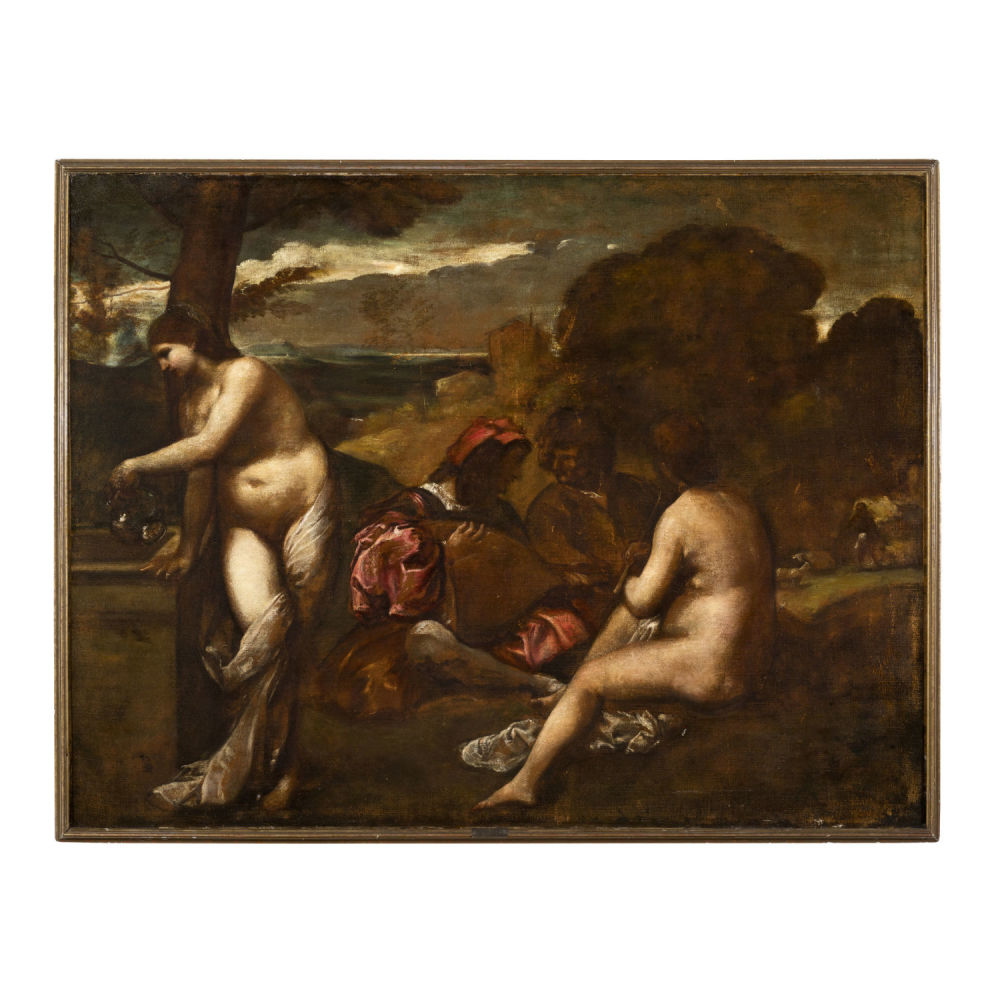
Tiziano Vecellio (Pieve di Cadore 1488/1490 - Venezia 1576) bottega di Concerto campestre (incompiuto) Olio su tela 105 x 138 cm La tela, nelle parti definite, evidenzia una squisita qualità, un far pittorico deciso e tipicamente veneziano per il sapiente uso della pennellata sfrangiata e dello sfregazzo. Supporto, materiali e tecnica inducono a datare la tela nel XVI secolo, e in virtù di queste considerazioni, si avvalora l'ipotesi che essa sia uscita dalla bottega del Tiziano, ovvero, a nostro avviso, realizzata sotto la sua diretta supervisione. L'opera originale, conservata al Louvre, è stata attribuita a Giorgione ma oggi l'opinione comune degli studiosi riconosce in Tiziano l'autore. Il tema colto e sofisticato, allude ai piaceri arcadici e al piacere dei sensi, alla purezza e all'eros alla simultaneità del visibile e dell'invisibile, dell'umano percepire e della percezione poetico filosofica. Appartenuta ai Gonzaga, venne acquisita da Carlo I d'Inghilterra e poi dal banchiere francese Eberhard Jabach, che a sua volta la vendette, nel 1671, a Luigi XIV re di Francia. Il celeberrimo dipinto Déjeuner sur l'herbe di Édouard Manet è l'omaggio dell'artista francese a quest'opera che ebbe modo vedere e amare profondamente. Tiziano Vecellio (Pieve di Cadore 1488/1490 - Venice 1576) workshop of Country Concert (Unfinished) Oil on canvas 105 x 138 cm The canvas, in the defined parts, highlights an exquisite quality, a decisive and typically Venetian pictorial approach due to the skillful use of sfrangiato and sfregazzo. Support, materials, and technique led to dating the canvas in the 16th century, and by these considerations, the hypothesis is supported that it came out of Titian's workshop, or, in our opinion, created under his direct supervision. The original artwork, now in the Louvre, was attributed to Giorgione but today the common opinion of scholars recognizes Titian as the author. The cultured and sophisticated theme alludes to Arcadian pleasures and the pleasure of the senses, to purity and eros, to the simultaneity of the visible and the invisible, of human perception and poetic-philosophical perception. Having belonged to the Gonzaga family, it was acquired by Charles I of England and then by the French banker Eberhard Jabach, who in turn sold it, in 1671, to Louis XIV, king of France. The famous painting Déjeuner sur l'herbe by Édouard Manet is the French artist's homage to this artwork that he had the opportunity to see and love deeply.