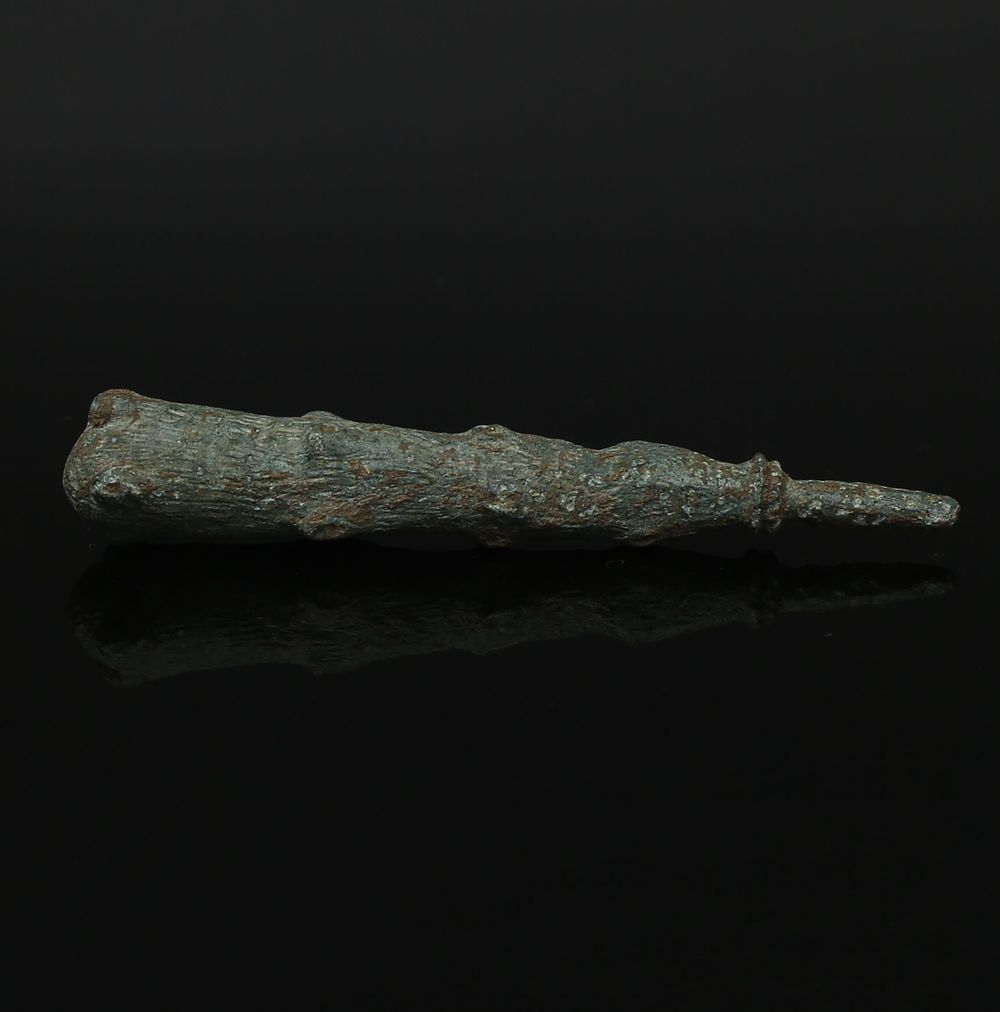
Asta Bidspirit | Etruscan Herakles club
Etruscan Herakles club - ITEM: Herakles club MATERIAL: Bronze CULTURE: Etruscan PERIOD: 3rd - 1st Century B.C DIMENSIONS: 70 mm x 12 mm CONDITION: Good condition PROVENANCE: Ex European private collection, Ex Galerie Bader (1976), Ex private collection, M.E.S., Switzerland Comes with Certificate of Authenticity and Export Licence. If you are from outside the European Union, we will have to apply for the export licence again for your country, this takes 4 to 6 weeks and has a cost of 5% of the amount of the sale, this amount will be added to the final invoice. Herakles, known as Hercules in Roman mythology, was a popular figure in Etruscan art and religion, often depicted with his characteristic club, lion skin, and muscular physique. The Etruscans, who had strong cultural ties to the Greeks, adopted Herakles into their pantheon as Hercle, adapting his image and mythological exploits to fit their own artistic and religious traditions. His club, a symbol of his immense strength and heroic feats, was a constant feature in Etruscan representations, appearing in bronze figurines, engraved gemstones, and painted ceramics. Unlike Greek depictions that emphasized his role as a demi-god completing the Twelve Labors, Etruscan art sometimes portrayed him in a more localized, protective role, highlighting his connection to divine favor and power. Etruscan mirrors and engraved bronze plaques frequently featured scenes of Hercle engaged in heroic struggles, often battling monsters or performing feats of strength. His club was not only an emblem of brute force but also a representation of his endurance and perseverance, qualities admired in Etruscan society. Some depictions show Hercle interacting with other deities, such as Uni (the Etruscan counterpart of Hera), suggesting that his role extended beyond that of a wandering hero. In temple decoration, terracotta antefixes and reliefs sometimes included images of Hercle, reinforcing his status as a divine protector and a figure associated with strength and victory. The presence of Herakles in Etruscan funerary art further reflects his significance in their belief system. His club, sometimes placed beside him or held aloft in triumph, may have symbolized his role as a guardian of the dead or a guide to the afterlife. Some tomb paintings depict scenes of combat or victory, perhaps serving as metaphors for overcoming death itself. The persistence of Hercle in Etruscan art and his later absorption into Roman culture as Hercules highlight his enduring legacy as a heroic and divine figure.